Vielight Intranasal Light
Therapeutic light for focus, calm, and easier breathing.
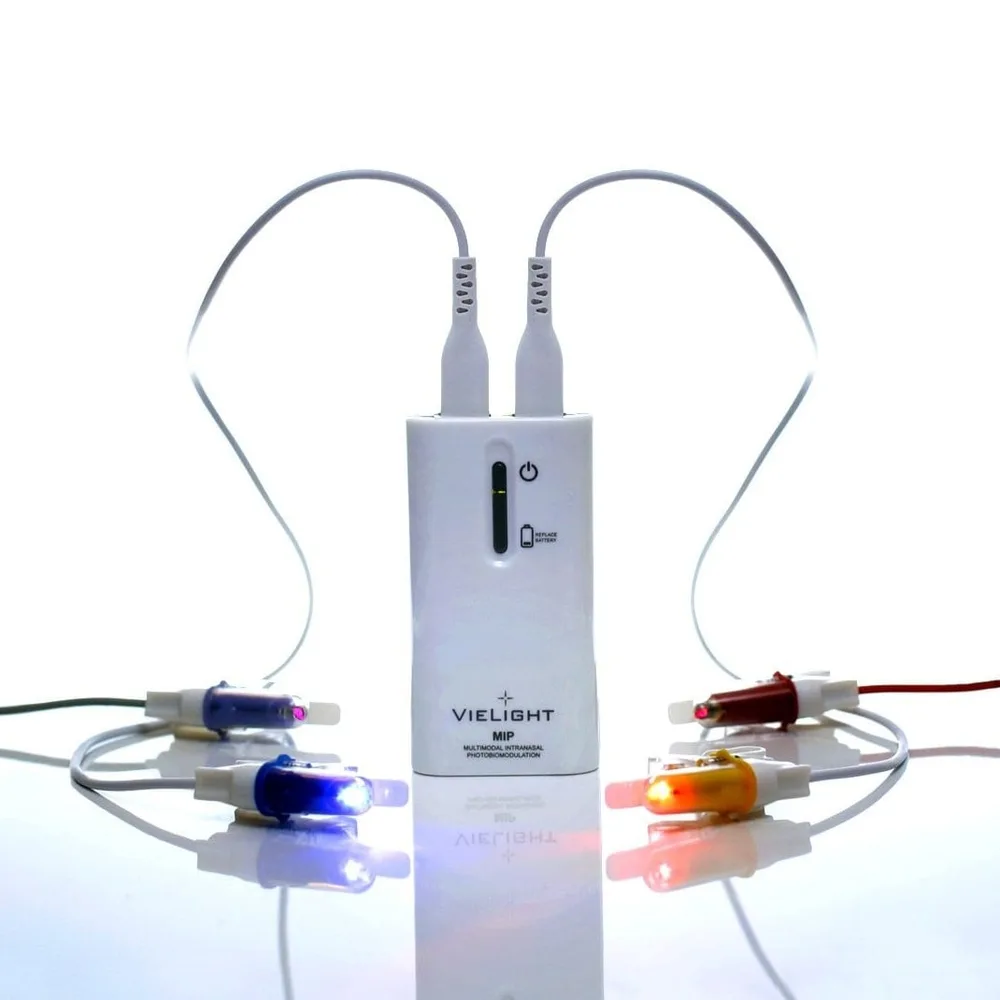
Our Vielight MIP delivers gentle red, near-infrared, or blue light through a small clip that rests just inside the nose. It’s quiet, hands-free, and therapeutic, so you add it to a modality you’re already doing, like the Sound Lounge or compression boots.
Photobiomodulation, or PBM, is the science behind red light therapy: specific colors of light are absorbed by the mitochondria, the energy centers in your cells. Vielight, a Toronto company, designs its devices to deliver that light from inside the nose, where a thin lining and a rich blood supply make an easy doorway.
Vielight’s MIP works with nose-clip applicators in four colors of light: near-infrared (810 nm), which pulses at 10 Hz for relaxation or 40 Hz for focus; two reds (633 nm and 655 nm), which Vielight designed for whole-body wellness and immunity; and blue (470 nm). Each session runs 25 minutes and switches off on its own.
Because it’s hands-free, it pairs naturally with the Sound Lounge, compression boots, PEMF, or red light. You get more from the same visit, with no extra time.
What to Expect
What a Session Feels Like
You wear it during another modality, like the Sound Lounge or compression boots, with a small clip resting just inside one nostril. The light itself is gentle: most people don’t feel it, and some notice a little warmth. The clip can irritate the inside of the nose a bit, especially at first, so tell us and we’ll adjust it. The session runs 25 minutes and switches off on its own. Every client gets a fresh, single-use silicone sleeve on the applicator, and we clean it with 70% alcohol before and after each use, following Vielight’s care guide.
You may notice
Who it's great for
How Often to Come, and What It Costs
Add it during another session, like the Sound Lounge, PEMF, compression boots, or red light. It isn’t used in the saunas, the Cryo Float, or the hyperbaric chamber. Members pay $30. It’s an add-on, so it doesn’t count toward a membership’s modalities.
Recommended frequency
Safety & Contraindications
Do not use if you have any of the following — consult your physician
Pairs Well With
PEMF Therapy
Recharge your cells. Restore your body.
Learn More →RecoveryCompression Therapy Boots
Flush the fatigue. Recover faster.
Learn More →Neuroscience & SoundNeuroVizr + InHarmony Sound Lounge
Guide your brain. Reset your nervous system.
Learn More →Salt TherapyHalo Therapy
Breathe salt air while you relax in the warmth.
Learn More →The Science & Research
For the curious: how Vielight Intranasal Light works in the body, the studies behind it, and the areas researchers are exploring. Tap a topic to open it.
How it works in the body
Red and near-infrared light are absorbed by cytochrome c oxidase, a key enzyme in the mitochondria, which helps cells make more energy (ATP) and supports a calmer inflammatory response. The inside of the nose has a thin lining and a rich blood supply, so it’s a convenient doorway for light. Vielight’s near-infrared applicator also pulses at brain-wave rhythms: 10 Hz (alpha), linked with relaxation, and 40 Hz (gamma), linked with focus.
Light absorbed by the mitochondria supports cellular energy (ATP)
A calmer inflammatory response, a theme across photobiomodulation research
Near-infrared light pulsed at 10 Hz (relaxation) or 40 Hz (focus)
Light on the nasal lining, studied for nasal comfort and airflow
Research & clinical evidence (3 studies)
Light in the Nose for Allergies
In a double-blind trial, 62 people with allergic rhinitis had 8 sessions over a month of red and infrared light in the nose, or a device that gave off no light (International Forum of Allergy & Rhinology, 2025).
- ·Better nasal airflow (peak nasal inspiratory flow)
- ·Less stuffiness and better allergy control
- ·Sense of smell didn’t change
Low-Level Light for Allergic Rhinitis
A 2024 meta-analysis pooled 16 studies of low-level light therapy for allergic rhinitis (International Archives of Allergy and Immunology, 2024).
- ·Nasal symptoms and quality of life improved after treatment
- ·Very few side effects were reported
- ·In the smaller set of studies that compared it with placebo, the difference wasn’t statistically significant
Headset and Nose Light for Dementia
Five people with mild to moderately severe dementia used an 810 nm headset-plus-nose-clip device weekly in the clinic and a nose-clip-only device daily at home for 12 weeks (Photomedicine and Laser Surgery, 2017).
- ·Memory and thinking scores (MMSE and ADAS-cog) improved significantly
- ·Better sleep, less anxiety, and fewer angry outbursts were reported
- ·Scores declined during the 4 weeks off treatment
Areas it may support
Non-medical. These are areas of active research and client-reported benefit, not medical diagnoses or treatment claims.
Experience Vielight Intranasal Light
at MK Wellness
17844 Mound Road, Suite F · Cypress, TX 77433
Book via Vagaro · (346) 805-8928 · No long-term contracts
MK Wellness services are non-medical and not intended to diagnose, treat, cure, or prevent any condition. The research cited on this page reflects published studies and does not constitute medical advice. Individual results vary. Consult your physician before starting any wellness program.